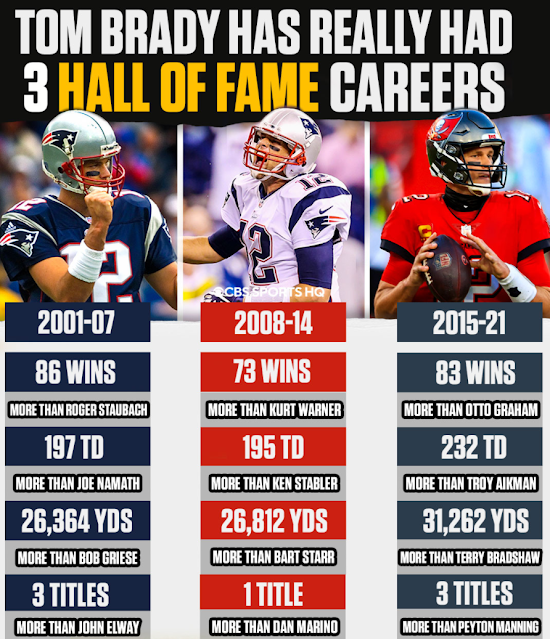
Yesterday evening ESPN reported that after 22 seasons, 7 Super Bowl wins (10 appearances) and over 86,000 passing yards, Thomas Edward Brady Jr ("Tommy"), was retiring. As the tributes poured in the news was seemingly confirmed by Brady's company, TB12...
Sunday, January 30, 2022
Man in the Arena...No More?
Thursday, January 27, 2022
What is Bangladesh?
That's a question Amy Schneider will likely not forget anytime soon. The 42-year-old engineering manager's 40-game winning streak, second only to Ken Jennings' 74-wins way back in 2004, came to a dramatic end after she couldn't correctly guess the game's "Final Jeopardy." Librarian Rhone Talsma, however, did know what was the only country whose name ends with an "H", and overtook her to become the new champion. The popular Schneider had "rocketed to TV fame over the past two months...and even led to a bump in ratings for the long-running game show; earlier this month, “Jeopardy!” was the most-watched non-football program on TV." But don't feel too bad for her, she leaves "with $1,382,800, the fourth-highest regular season winnings ever behind Jennings ($2.5 million), James Holzhauer ($2.4 million in 32 games) and Matt Amodio ($1.5 million in 38 games)."
For those still curious about Bangladesh, here's a few key factoids:
Source: Leading EdgeTuesday, January 25, 2022
How the U.S. Economy Works
Deficits, stimulus, bubbles...confused about how our economic system works? Let comedian Mo Amer explain it:
Sunday, January 23, 2022
Pandemic Stocks See Red
Global equities are having a very difficult start to 2022 as inflation crashes the decade-plus liquidity party. Investors fearing the Fed will not only take away punch bowl but also turn off the lights are fleeing stocks. Nowhere is this sentiment more evident than among growth companies that flourished during the COVID-19 pandemic. The Visual Capitalist has great chart showing the state of some popular pandemic and tech-centric stocks in January:
Source: The Visual CapitalistSaturday, January 22, 2022
NASDAQ: Then and Now
The Tech sector has had a great dozen years, propelled by ultra-low interest rates and investors' growing appetite for risk. The NASDAQ Composite (QQQQ) has thrived in the anemic post-GFC economic environment, gaining nearly 21% per year since 2009. However, inflation is now a real threat to the economy, which means potentially tighter monetary conditions in the near future. Many Tech stocks, with expected profits far into the future, are long duration assets that are particularly sensitive to interest rate movements, akin to bonds. Since hitting a peak in mid-November, the QQQQ has fallen over 14%. But that's the whole index; underneath some erstwhile high-flying themes are getting hit harder. Cybersecurity stocks (represented by the HACK ETF) are down over 19%, software/ SaaS companies (SKYY ETF) are down about 25%, and worst of all, fintech stocks (FINX ETF) are down over 33%.
When the "dotcom" bubble burst in 2000, the NASDAQ ultimately fell 80% over more than 2 years. We are nowhere near that, but how does the current pace of Tech decline compare to 2000? Much better, (for now) as shown below.
Biden To the Fed: Do Your Job!
The post-Global Financial Crisis ("GFC") environment has long been plagued by low growth and deflationary pressures. Supported by by ultra-low interest rates, growth hungry investors have for years piled into risky assets like cryptocurrency and companies with questionable "growth-at-all costs" business model. Profits? What's that?...Investors merrily did so because of the justified belief that the Federal Reserve had their backs. The stock market is, of course, not a part of the Fed's dual mandate of stable prices and maximum employment. However, successive Fed regimes have been wary of any negative feedback loop a declining stock market might have on the real economy and typically responded to market volatility with injections of liquidity. The Fed's obsession with the so-called "wealth effect" has contributed to growing economic inequality, even by the Fed's own admission. But suddenly, some would say predictably, inflation is back after four decades (admittedly, this blog was firmly in the transitory camp). The Consumer Price Index rose to a 39-year high of 7.1% in December, well above the 3.2% average over the past 42 years and the 1.8% per annum since the GFC.
Wednesday, January 19, 2022
How Much Sport is There in Professional Sports?
The long MLK weekend had six NFL wildcard matchups under the expanded play-off format. Sure, five of the six of the game were uncompetitive (though the Cowboys vs 49ers game made up for some of that). But that's not the point. While there were six games of 60 minutes each, how much football did we actually see? Well, according to a study from the WSJ from a decade ago, the average amount of time the ball is in play on the field during an NFL game is about 11 minutes! Where does the rest of the time go? Here's a helpful graphic from the Journal:
If there's so little actual football in a football game, what do the networks do with the other 190 minutes in a typical broadcast? Not surprisingly, "commercials take up about an hour. As many as 75 minutes, or about 60% of the total airtime, excluding commercials, is spent on shots of players huddling, standing at the line of scrimmage or just generally milling about between snaps." All this is facilitated by the fact that in American football the clock is allowed to "run for long periods of time while nothing is happening. After a routine play is whistled dead, the clock will continue to run, even as the players are peeling themselves off the turf and limping back to their huddles. The team on offense has a maximum of 40 seconds after one play ends to snap the ball again."
Felicidades España, los Campeones del Mundo!!
An imperious defense and dazzling passing helped La Roja to win the World Cup Fewest Goal Conceded in World Cup: 1 Golden Ball (Best Playe...
-
Russian oligarch Roman Abramovich purchased Chelsea FC in 2003 for £140 million (£60 million for the club plus £80 million of debt). His la...
-
This is more a discussion than a "debate" between two giants of the economics profession. Both are Democrats and agree on the basi...
-
Even though many of us are still working from home and days of the week can sometimes meld into one another, the weekend still seems to (and...