Showing posts with label Interest Rates. Show all posts

Sunday, July 20, 2025

The Resistance Begins with Jerome Powell?

The Federal Reserve is, arguably, the most important financial institution in the world. It is responsible for managing America's monetary policy, monitoring and regulating the nation's banks, and maintaining the stability of the U.S. financial system (and by extension, the global financial system; because what happens in the U.S. never stays in the U.S.). But the Fed is also, by design, a staid and dispassionate institution; run by bland, competent technocrats. It's the last place you'd think to find fodder for The Daily Show. And yet, here was Jason Klepper recently doing an extended segment on Trump's beef with Fed Chair Jerome Powell. Klepper jokes that Trump's so angry with Powell, you' think he caught him with [Melania] at a Coldplay concert!! 

Trump's dissatisfaction with Powell stems from the fact he refuses to do the President's bidding and lower interest rates as demanded. Powell is strictly apolitical, which irks Trump no end. After all, Big Lawmajor media companies, and even the Supreme Court have effectively bowed to Trump. So why not the Fed Chair, who Trump himself appointed? Moreover, Powell has refused to step down before his term is finished next year and has steadfastly maintained he will fight any attempt to remove him. That sounds like a challenge, but Trump realizes that firing a Fed Chair (even if he had the authority to do so) is a huge risk for the economy. Fed independence is a core part of the U.S. financial system and Wall Street has come to Powell's defense. So, is Powell, of all people, the hero the Resistance has been waiting for?


Saturday, September 23, 2023

Why Bidenomics Gets So Little Love? Blame David Brooks!

Bidenomics is the President's signature economic plan, meant to grow the economy from the middle out and bottom up. It is a rejection of the Republican party's core policies of "trick-down economics" and is expected to be financed in part by greater taxes on the wealthy and corporations. And it seems to be working: (i) 13 million jobs added since Biden's inauguration (January 2021)--including 800K of those elusive manufacturing jobs, (ii) unemployment at less than 4%, and (iii) the strongest growth since the pandemic of any major economy. Yes, inflation reached a 40-year high in June of last year with a yoy increase of 9.1% but thanks to the Fed's aggressive rate hikes and supply chain normalization, CPI has steadily declined (though still elevated at 3.7%). If the conventional wisdom about elections is true, that "it's the economy, stupid", then Biden should be sitting pretty. 

Yet, despite robust job growth, rising wages, and falling inequality the electorate is anxious about the state of affairs, very anxious; an NBC poll at the end of June found 74% of Americans feel the country is heading in the wrong direction. Huh? Why is Biden not getting credit for the economy?

Inflation is certainly a part of it. A September Harris poll for the Guardian newspaper found that "two-thirds of respondents (68%) reported it’s difficult to be happy about positive economic news when they feel financially squeezed each month (Republicans: 69%, Democrats: 68%)." And there is hard data to support such disquiet. While most measures show real wages are up since prior to the pandemic, Jason Furman (Harvard economist and chair of the Council of Economic Advisers under President Obama) calculates that [they] are still 3-5% below their immediate pre-pandemic trajectory. In other words, things were already improving under Trump then the pandemic hit, followed by nearly double-digit not transitory inflation causing real wages to plummet. Workers' real incomes are now back up to Q1 2020 levels, but still below the trajectory they were on in the waning years of the Trump administration. Simply put, Americans feel real wages should be higher.   


But the Harris/Guardian survey finds another, more dire, reason for voters' dissatisfaction: mistrust in media and government. Two-thirds of Americans (65%) believe that the economy is worse than the media makes it out to be. For example, while the unemployment rate was close to a 50-year low in August at 3.8%, the poll found that "51% [surveyed] wrongly believe that unemployment is nearing a 50-year high rather than those who believe it’s actually low (49%)". And it wasn't just Republicans, a sizable number Independents and Democrats also felt the same.


Taken together, it's not much of a surprise that more than half of Americans (53%) believe the economy is getting worse instead of better or staying the same. Republicans and independents were more likely to think it’s getting worse (72% and 58%, respectively, v Democrats: 32%).

That brings us to David Brooks, the New York Times' conservative columnist and recovering neocon/Republican.  In a June op-ed, he also explored why Biden was struggling to make his economic case. Sure, inflation was a part of it, but Brooks believed the media and (crucially) a bruised national psyche were mainly to blame. What's that again, David? National psychology. Brook argues that during the Trump era Americans suffered "a collective moral injury, a collective loss of confidence, a loss of faith in ourselves as a nation". It is reflected in a recent Gallup poll showing Americans' "satisfaction with their personal lives is nearly four times as high as their satisfaction with the state of the nation". And the media isn't helping, over the past couple of decades headlines have grown starkly more negative, particularly from right-leaning outlets, stoking anger and distrust. Hmm...like if a nationally syndicated columnist were to tweet on his NYT X account about the outrageous price ($78) of an airport hamburger and fries meal as an example of why Americans are so gloomy about the economy, while conveniently omitting that 80% of the tab ($62) was for his bar bill.


Maybe he was speaking an "emotional truth". Regardless, intentional or not, he validated his own media thesis about trust. Does this mean Biden is toast...no, not really. Because, at this point Trump is almost a lock for the Republican nomination leading by 50 points over his nearest rival, Ron DeSantis in recent polls...but Biden wins against Trump in a rematch! Politics!!

Sunday, April 17, 2022

A Hot Housing Market is Bad for Homebuilders?

Sometimes, there can be too much of a good thing. Since the start of the Covid-19 pandemic an already strong housing market has become super-charged, as unprecedented demand pushes home prices through the roof (pun intended). The Case-Shiller National Home Price Index has gained an astonishing 30% YoY, as shown below (click to enlarge). Makes the HPA of the 2000s look almost mild by comparison!


This should be a great situation for homebuilders, no? Umm...not really. Here's a chart of the SPDR S&P Homebuilders ETF, which tracks a broad-based, equal-weighted index of US companies involved in the homebuilding industry. It's down nearly 30% after peaking in early December. What gives? Bloomberg's Odd Lots Podcast, hosted by Joe Weisenthal and Tracy Alloway, has a good explanation. While Housing Starts have been growing with housing demand, Housing Completions, have been going sideways recently. A scarcity of materials and labor means those homes don't actually get built. There's now a clear and growing gap between these two series as shown below:


The upshot is investors are worried that with interest rates (and, with it, mortgage rates) rising, housing demand may cool by the time all these homes are finally completed, and homebuilders might have to take write-down on the assets. So much so, that KB Home, a leading homebuilder in the U.S., is actually trading below its book value! 

An overreaction? Possibly. Given that the U.S. has a shortage of 4-5 million housing units which will only grow as 10 million new households are formed in the next 10 years, it seems like most of these homes will get snapped up, if not by individual households, then investors who buy to rent out. Single-family rentals are a big business. So, a good time to buy KH Home (NYSE: KBH)?

Thursday, March 24, 2022

Summers to Powell: Do as I Say, Not as I Said

Last Wednesday the Federal Reserve wrapped up its two-day March FOMC meeting and announced a largely expected 25 bp rate hike, the first such action since December 2018. Back then the markets threw a tantrum, dropping 9% on the month, causing the Fed to back off any further actions, because, you know, the 'Fed put.'  Beginning with Ayn Rand-devotee Alan Greenspan, Fed Chairpersons have, to a great extent, measured their job performance against the fortunes of the stock market, the most visible, though inaccurate, reflection of the broader economy. But for much of the post-GFC period inflation and economic growth had stayed stubbornly low, and after a while the Fed's highly accommodative policies primarily served to boost financial markets. The only real issue was asset inflation and historic inequality--but, almost by definition, that doesn't matter. Trickle down, right?

Well, things are a little different now, with inflation at a 40-year high, and potentially getting worse. The Fed is in the uncomfortable position of choosing between its favored measured of success, the stock market, and its actual mandate of price stability. But old habits die hard, and the Fed moved gingerly last week with a 0.25% hike and a lot of soothing talk. The markets ripped higher, almost as if laughing at the prospect of the Fed being more aggressive, led curiously by retail investors (?). But being aggressive--a lot more aggressive--may be what's needed, according to Harvard economist Larry Summers. Prior to the FOMC meeting last week, Summers wrote that the Fed needed to hike rates to at least 5% or risk bringing stagflation and recession on the US economy. Following the FOMC's relatively tepid rate move, Summers responded with a stinging Op-Ed in the Washington Post, saying: "The stock market responded positively Wednesday to the Federal Reserve’s move to raise interest rates...I wish I could share that enthusiasm. Instead, I fear, the economic projections of the Federal Open Market Committee (FOMC) represent a continuation of its wishful and delusional thinking of the recent past." Wishful and delusional; tell us what you really think Larry.

Summers' argument stems from what has been a central principle of anti-inflationary monetary policy for decades, namely that to reduce inflation it is necessary to raise real rates. He writes "yet, because of upward revisions in the inflation forecast, the Fed’s predicted real rates have actually declined in recent months. In other words, the FOMC’s plans do not even call for keeping up with the rising inflationary gap. It is hard to see how interest rates that even three years from now will be about 2 percentage points less than current rates of inflation can reasonably be regarded as providing sufficient restraint." He goes on to say "perhaps the FOMC members are wary of pessimistic forecasting. But why shouldn’t they forecast realistically...the credibility of the Federal Reserve is a precious asset. It should not be lightly sacrificed."

                                    Source: St. Louis FRED, Mantabye

And yet, ironically, Summers may be part of the reason the Fed has been so cautious to begin with. Summers has been successful at reviving the idea of 'secular stagflation' in recent years, which is that demographics, global savings glut, and technology trends are reducing growth and inflation, and the imbalance between savings and investment is pulling down real interest rates. Buttressing the case is what we had seen over the past two dozen years in the U.S. and Europe and perhaps far longer in Japan, at least until the pandemic. Growth has been consistently below expectation, with chronically sluggish demand and low inflation, "just as one would expect in the presence of excess saving. Absent many good new investment opportunities, savings have tended to flow into existing assets, causing asset price inflation." The Fed seemed to buy into that thinking when they persistently described inflation as "transitory." Even after Summers had reversed course in 2021 and warned that continued large scale monetary and fiscal stimulus in response to the pandemic could lead to price instability, many still felt secular stagflation was the bigger risk. In fact, Paul Krugman, quoted Summers to Summers to make the convincing case more stimulus was warranted.  

Whether it was the market's response, Summers' comments, or whatever, by Monday the Fed took a much harder tone on rates, with Chair Powell stating, "the labor market is very strong, and inflation is much too high," and that the Fed was open to multiple 50 bps rate hikes and, perhaps, even reducing the Fed balance sheet at the same time. Okay...

Sunday, January 23, 2022

Pandemic Stocks See Red

Global equities are having a very difficult start to 2022 as inflation crashes the decade-plus liquidity party. Investors fearing the Fed will not only take away punch bowl but also turn off the lights are fleeing stocks. Nowhere is this sentiment more evident than among growth companies that flourished during the COVID-19 pandemic. The Visual Capitalist has great chart showing the state of some popular pandemic and tech-centric stocks in January:

                                        Source: The Visual Capitalist

Saturday, January 22, 2022

NASDAQ: Then and Now

The Tech sector has had a great dozen years, propelled by ultra-low interest rates and investors' growing appetite for risk. The NASDAQ Composite (QQQQ) has thrived in the anemic post-GFC economic environment, gaining nearly 21% per year since 2009. However, inflation is now a real threat to the economy, which means potentially tighter monetary conditions in the near future. Many Tech stocks, with expected profits far into the future, are long duration assets that are particularly sensitive to interest rate movements, akin to bonds. Since hitting a peak in mid-November, the QQQQ has fallen over 14%. But that's the whole index; underneath some erstwhile high-flying themes are getting hit harder. Cybersecurity stocks (represented by the HACK ETF) are down over 19%, software/ SaaS companies (SKYY ETF) are down about 25%, and worst of all, fintech stocks (FINX ETF) are down over 33%.  

Source: Yahoo Finance, Mantabye

When the "dotcom" bubble burst in 2000, the NASDAQ ultimately fell 80% over more than 2 years. We are nowhere near that, but how does the current pace of Tech decline compare to 2000? Much better, (for now) as shown below.

Source: Yahoo Finance, Mantabye

That's not surprising, given that today AAPL, MSFT, GOOG, AMZN, TSLA, and FB make up 42% of the QQQQ (as of 12/31/2021). With exception of Tesla, the other five companies are among the most profitable in the world. What is comparable to the 2000 NASDAQ's rate of fall is the drawdown in Bitcoin, which has fallen ~40% in almost as many (business) days. Makes sense

Saturday, January 8, 2022

The Year in Markets: 2021 Edition

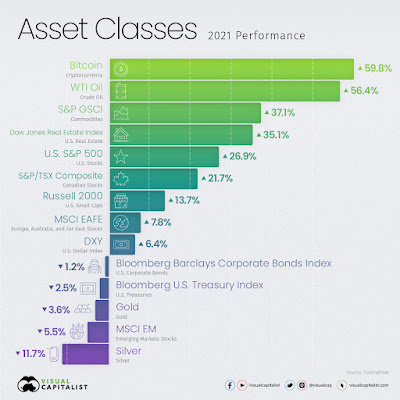
A couple of great charts from the Visual Capitalist showing how major asset classes performed in 2021 (click below to enlarge). It was another strong year for developed market stocks. The S&P 500 was up nearly 27% beating 2020's impressive 15.5% gain, with every sector positive. The MSCI EAFE (developed markets xUSA) was up close to 8% (versus +5% in 2020). But the year's best performing asset was Bitcoin, up nearly 60%, which is great...but far less than the nearly 380% the digital coin gained in 2020. Of course, now that Bitcoin has gone mainstream (as evinced by its nearly $1 trillion market cap and constant market tracking on CNBC alongside major stock indices), such triple-digit returns are unlikely, even as its volatility and correlation to public equities goes up.

Energy also had a great 2021, after struggling mightily in 2020. Oil was up over 56% after dropping more than 21% last year. Energy was also the best performing sector in the S&P 500, up nearly 48%, followed by Real Estate (+42.5%), Tech (+33.4%) and Financials (+32.5%). The "weakest" S&P 500 sector was Utilities, up only 14%.

What didn't work in 2021 was fixed income and EM stocks. Treasuries and bonds fell 2.5% and 1.2%, respectively, as inflation and interest rate volatility jumped. The benchmark Bloomberg Barclays US Aggregate Index declined by 1.5%, its first annual loss since 2013 and only for the fourth time in nearly 40 years. EM economies are beneficiaries of low US interest rates and so, naturally, rising rates also hurt EM stocks. Surprisingly, last year's best performers silver (+47.4%) and gold (+24.6%), struggled in 2021, despite a long history of being an inflation hedge. Perhaps because of Bitcoin?   


Sunday, November 21, 2021

The Return of Greenspan's Conundrum and a Market Crash?

Back in 2005, then Fed Chair Alan Greenspan expressed frustration that despite hiking the Fed’s target rate six times, by a total of 150 basis points, long-term interest rates barely budged. He called it a "conundrum." (Years later the Fed's own research would provide evidence of the tenuous connection between the federal fund rates and long-term yields). 

Well, it's important because not long after in 2006 the yield curve inverted and not long after that the global financial system crashed. As Cullen Roche of the Pragmatic Capitalist notes the conditions today seem eerily familiar:

  • Prices are rising across the board at an uncomfortable pace
  • The Fed is getting worried about all of this and has started discussing potential rate hikes
  • The long end of the curve has barely budged

However, back in 2005, the benchmark 10-year Treasury yield was hovering around 5%, today it's at 1.5%. As Roche notes, if the Fed starts raising rates they don’t have the same 5% of wriggle room before the curve starts to invert. "They have barely any room at all." 

As of now the bond market is strongly signaling that it thinks “inflation is transitory.” To use the gambling analogy to financial markets (which seems apropos), the bond market is the casino...and the "house" always wins (well, almost always). So the Fed is in a precarious position of having to choose between saving the financial markets (which is not in its mandate, but you know, the "wealth effect") and controlling inflation (which is a part of its dual mandate). Sure, sure this time it's different; after all, in the mid-2000s there was a massive housing bubble...but only in hindsight. Could the same not be said about a corporate debt bubble today?

Regardless, it's a fascinating exercise for portfolio managers. Inflation and the potential Fed hikes should be bad for bonds. Yet, the dangers of an ensuing bear market will likely cause fixed income assets to surge! Quite the conundrum? So, do you allocate 60/40 to stocks and bonds or 40/60 or even 20/80? Perhaps it's time for gold to finally shine again. 

Sunday, July 11, 2021

The Rich are All Right

That's the summary of Capgemini's 2021 World Wealth Report, the Victoria's Secret catalogue for private bankers and wealth managers. To reiterate what we already know, "despite the pandemic, investor bullishness boosted global [millionaire] population wealth growth." According to the report, the number of High Net Worth Individuals ("HNWI") grew by 6.3% in 2020, faster than the 6.1% CAGR between 2013-2019. The number of millionaires grew fastest in North America (not surprisingly), followed by the Middle East (somewhat surprising, given how oil performed, but I guess the region is much more diversified than I knew). Click charts to enlarge.

Overall, there are now over 20.5 million HNWIs (millionaires) in the world--seems like a lot, but that's just 0.26% of the world's population. 

So, where are the rich investing their money? The usual places: equities (30%), cash (24%, higher than I would have expected with the risk-free rate at ~0%, but we were just in a pandemic), fixed income (18%), real estate (15%) and alternatives (14%). Looking back about twenty years, you see a big shift away from low-yielding fixed income (30% to 18%) and increasing embrace of higher returning alternatives (broadly speaking, private equity and hedge funds).

What's interesting, but in no way surprising, is the changes to the sources of wealth, particularly in the U.S., over the past quarter century. In 1993, inherited wealth was the biggest source of affluence among the 400 richest individuals in the U.S. Today, it's almost all self-made and mostly from Technology and Finance. So, that's good...even if inequality is much higher now than 25 years ago. 

Saturday, March 20, 2021

Krugman vs Summers: Round 2?

The yield on the 10-year Note has risen 89% YTD as of 3/19 (from 92 bps to 173 bps) and 223% since a low of 54 bps back in July. Obviously % changes from such a low base are going to be dramatic. But it's got market analysts and economists somewhat freaked out about the "i" word.

To be sure, the rise in yields has tracked the progress of vaccines approvals and improvements in the economy...but has risen sharply in recent weeks as the Democracts successfully pushed through a massive $1.9 trillion stimulus. While Republicans predicatably blasted the deal, one of its harshest critics has been Larry Summers who believes the recently passed $1.9 trillion stimulus will "set the economy on fire." Err, that's economist speak for 'are you outta your f***ing minds?'

Last month we highlighted a fascinating discussion or "debate" between Paul Krugman and Summers concerning the yet-unpassed stimulus package. Essentially, both agreed that more support for the economy and, in particular, vulnerable groups was needed, but disagreed on the size of the package. Krugman wanted Biden to go big or risk a weak recovery, while Summers thought the size of proposed stimulus was overkill and risked stoking inflation, if passed.

Well, the stimulus did passed (surprisingly? shockingly?), giving the Democracts a huge political win. But what does it mean for inflation? Bloomberg's Wall Street Week invited both Krugman and Summers to make their points again this week: 


Krugman dismissed worries of 1970s-style inflation saying the latter did not transpire overnight, but took hold gradually over a decade of poor policies and oil shocks. His big argument continues to be that the bigger risk is not doing enough to support the economy. The fiscal stimulus had to be massive because with short-term interest rates near zero, stimulatory monetary policy options are limited. However, precisely because rates are so low the Fed has a lot more options should the economy heat up. And Krugman believes the Fed is up to the job of managing price stability. Period. So, he sees an asymmteric risk-reward here.

Summers, on the other hand, sounds even more critical than he did a few weeks ago, calling the stimulus package the "least responsible fiscal macroeconomic policy we've had for the last 40 years." Blaming the instransigent Democratic left and all Republicans. He was also pointedly critical of Krugman for bringing political analyses into what should be a rational economic discussion. We've covered all this previously. But what was surprising here was Summers' conviction that it would go all wrong; starkly warning that he thinks there is a 1/3 chance Fed will be behind the curve and we become an inflationary country, 1/3 chance the Fed surprises the markets, reacts hard and puts the economy in recession, and 1/3 chance that by some miracle he's wrong. 

So, I can see where Summers is coming from. Goldman Sachs and much of Wall Street is expecting 2021 GDP growth to about 8%, the fastest rate in 56 years! Unemployment at under 4% by end of 2021 and 2022 GDP growth at 4.5%! Whoa! Of course these are sell-side research forecasts which are always bullish ("...economy is growing, buy stocks!!" and Krugman has a wicked burn to just that point in the full version). But this chart from Blackstone does make that point, as does research from Summers and Furman. The BX graph (click to enlarge) shows the $2.2 trillion economic contraction Covid caused last year was largely (but not fully) offset by more than ~$3.5 trillion of federal aid even before the latest $2 trillion of stimulus. So, all this money is going juice growth and cause prices to rise, right?


Yes and no. The chart below shows the difference between nominal GDP and 10-year yields over the last 60 years. When the spread has been 5% or more, you've had a sharp rise in inflation (late '60s, '70s)...and based on analysts' forecasted 2021 GDP growth, the expected spread today is more than 6%!
Ergo, inflation? Summers is right?


...Not so fast. Analyses from the (leftish) Brooking Institution suggests growth will be
transient. Their study projects the U.S. economy will experience moderate above trend growth in the short-term, 2H 2021 and 1H 2022, but revert back to pre-Covid trends by end of 2022. However, without the Biden package, Brookings estimates the economy would not fully recover for a long time...just like after the Great Recession. So Krugman "wins"...again!


What's more, the biggest boost to the economy will come from aid to financially vulnerable households. Yeah, this set of analyses defintely favors Krugman. Ding! Ding! Ding! 


But what about short-term inflation...how bad can it get? Meh, probably not that bad. The Fed's biggest problem the last three decades has been not enough inflation. Another $2 trillion won't make much of difference against the generational forces of an aging population, shrinking workforce, and deflationary technology as discussed previously. As for bonds...well those same forces will continue to ensure that private savings>private investments across the OECD and keep interest rates low.


I'll say this again. The best rebuttal to Summers comes from Summers, who very persuasively made the exact same argument when he famously revived the "secular stagnation" thesis. So, Treasuries at 1.73% may actually be a buying opportunity! I'm sure European and Japanese pensions will be thinking so.

Sunday, February 28, 2021

Inflation Head Fake?

The financial markets freaked out last week as yields rose on fears, yet again (sigh), of growing inflationary pressure. The benchmark 10-yr Treasury yield briefly crossed 1.6% Thursday, the highest level in a year, sparking a sell-off in Growth and Momentum stocks. But so what? The 10-yr was back at only pre-Covid levels, and everyone knew those stocks were grossly overvalued...Yes, the 12-month CPI came in at 1.4% in Jan vs the average of 1.2% for 2020. And true, there is another $1.9T of stimulus on the way even as the economy is poised to take-off (Goldman Sachs is forecasting ~7% GDP growth for 2021). From that angle, you might expect some handwringing in the media about inflation... though sell-side research loves to cheerlead remind clients rising yields is good for stocks as it reflects strong fundamentals (there's never a bad reason not to own stocks).

But, what seemed to really have panicked the markets was the disorderly nature of the bond sell-off. The magnitude of the move last week was more than 2 standard deviations, which is typically associated falling equity prices. So last week both bonds and stocks lost value together. The nightmare scenario from a portfolio construction perspective! Anyways...continuing with what happened...Goldman Sachs' Portfolio Strategy team notes that long-duration growth stocks fared especially poorly, including a 15% sell-off in a basket of non-profitable tech stocks that had risen by 230% since the start of 2020. In contrast, cyclicals with falling sales in 2020 have returned +25% YTD. There was also the chart below, which got a lot of attention showing the 10-yr was now yielding as much as stocks and signaling potentially more outflows out of stocks as investors re-think their income source:   

But we've been here before...as the above chart shows, including famously in 2013 with the "Taper Tantrum." Each time growth has been slower than expected and inflation way lower than anticipated. I'm with PIMCO's Dan Ivascyn, who continues to see "powerful disinflationary trends. [And] after an initial recovery there is likely a world of excess capacity." In Ivascyn's opinion, inflation will remain contained due to secular trends in demographics, technology and weakness of organized labor. The upshot is a material risk of an "inflation head fake." 

Wednesday, November 18, 2020

The Fed Put is Real

The idea that the Federal Reserve is willing to adjust monetary policy in a way that is supportive of the stock market has been debated for decades. A new study by Anna Cieslak and Annette Vissing-Jorgensen puts the argument to rest. They found "compelling evidence of a Fed put going back to the mid-1990s."

The stock market is, of course, not a part of the Fed's dual mandate of stable prices and maximum employment. However, the Fed has often been wary of any negative feedback loop a declining stock market might have on the real economy and pays very close attention to it. But as many people have pointed out, for structural reasons, the stock market does not reflect the economy.

Anyways, back to the study, findings of which is neatly summarized at ZeroHedge:

Analyzing decades of Fed transcripts and minutes, Cieslak and Vissing-Jorgensen found that for every 10% decline in the stock market, a 32 bps rate would result, on average, at the next Fed meeting. The authors tested their model against numerous other macroeconomic variables and found that stock market developments were a better predictor of FOMC than any of them. Their model forecasted a 109 bps cut following the 34% market plunge in Feb-Mar. In response the Fed cut rates by 150 bps.

Not surprisingly, the study also found that an increase in the stock market didn't lead to corresponding increase in interest rates.

This asymmetric response may appear to be decidedly bullish for investors. However, because successive Fed regimes have conditioned traders to expect a dovish Fed response to market volatility, the Fed put could be increasingly less effective in the future (as increasingly bigger responses are needed to get the same effect). As the authors write, for the put to be effective the Fed has to "beat expectations" of how much they will cut. "That's why the Fed's job could get increasing difficult."


Sunday, August 30, 2020

Private Equity: Asset Class of the Decade With Room to Grow

Perhaps no industry has benefited more from 'lower for longer' than PE. Near zero interest rates are ideal for LBOs. And institutional investors desperate for higher returns have turned to PE as this FT article points out, which in turn draws from this MSIM tome. 

Consider CalPers' required rate of return as representative of public pension funds (most of whom are similarly underfunded):

Year 30-Yr Tsys Yield Required Return
1981 15.0 6.5
1992 7.8 8.8
2021 1.2 7.0

Historically, PE has produced about 12% annual returns and outperformed US equities on average by 3% annually between 1980 and 2010, though returns have started to come down since 2006 as the industry has grown. Still, with US equities expected to generate 5%-6% annual returns over the 10 next years, PE looks very attractive by comparison. (Moreover, periodic and subjective marking of positions result in more smoothed returns than public equity. So, higher returns AND seemingly lower risk? Perfect!!)

The popularity of PE is evident in the industry's rapid growth. As McKinsey notes private markets AuM has grown by 170% and the number of funds has doubled in the last 10 years. And the SEC is now expanding retail investors' access to PE, potentially giving further boost to asset growth. All of which may pressure returns to the point PE sees the same return degradation as HFs. But as long as interest rates stay near zero it should all be fine for PE managers.  

Felicidades España, los Campeones del Mundo!!

An imperious defense and dazzling passing helped La Roja to win the World Cup Fewest Goal Conceded in World Cup: 1   Golden Ball (Best Playe...