The Value factor has had a rough few years, ok...maybe more like a decade. As shown below (click to enlarge chart) Value massively underperformed Growth, particularly in the second half of the last decade with interest rates continuing to remaining near zero; 2020 was just brutal.
Sunday, May 9, 2021
Value's Comeback?
Sunday, February 14, 2021
Hedge Funds Have Decent January, Despite GME
GameStop was one of the most shorted hedge funds names coming into January. And last month's epic short squeeze that we wrote about (here, here and here) cost a number of big-name funds, like Melvin Capital, D1 and Point72, bigly--as they say.
The S&P 500 was flying high up to the week of the squeeze. The equity benchmark was up 2.6% through Jan 25, before closing the month down 1.1%. So, we figured the pain would be felt broadly across hedge fund land...but, so far, Jan HFRI hedge fund returns suggests the damage was limited to a select group of funds with the HFRI Fund Weighted Composite Index, the widely cited hedge fund benchmark, up 0.78%.
So, most hedge funds did well last month, at least the ones reporting early! Perhaps because it wasn't just WSB driving up the GME price, other hedge funds were in it too, amplifying the rally. (And, of course, Robinhood's liquidity issues shut out retail investors for a time which helped hedge funds.) True, the HFRI Equity Market Neutral Index was down 0.53%, but given this leveraged strategy is one of the most vulnerable to short squeezes, we're surprised (shocked even!) that losses were so...umm, pedestrian. Well, in any case, good for you hedge funds! You came out of a difficult month in good shape.
Venn has a good recap of the factors that drove equity returns and, of course, Crowding was the biggest driver (click to enlarger).
Tuesday, January 26, 2021
Momentum Wins Big in 2020
Venn has a nice recap of 2020 factor performances...and it's no contest. Momentum smoked all other factors and its own historical averages. Not a surprise when the market falls 34% in 30 days and then roars back 68% in the next 280. There were a couple of hiccups in June and November, but Momentum was up pretty much the whole year. (Click chart to enlarge)
Saturday, December 19, 2020
November Factor Upheaval: Top Quant Funds Caught in Epic Rotation
Some of the industry's biggest quant names, including AQR, Renaissance and Two Sigma dropped sharply in November after the positive news from Pfizer's vaccine trial spurred a violent rotation out of high-flying tech stocks (Growth, Momentum factors) into cyclical, beaten-down Value stocks. The below chart from GS shows the reaction of various sectors (H/T HumbleStudentoftheMarkets):
Hidden Figures: Unexpected Manager Exposures
Two Sigma's Venn platform has a very interesting analysis on the hidden exposures of fund managers. They analyzed the factor exposures of funds in four Morningstar catetgories: Large Growth, Large Value, Small Growth and Small Value.
First up Large Growth Funds, which according to Morningstar: Invest primarily in large US companies that are expected to grow faster than other large-cap companies. Growth describes companies with high earnings and sales growth rates and high valuations. These funds are expected to exhibit negative exposure to Value factors (like low price-to-book) and zero to negative exposure to the Small Cap factor (market capitalization).
The analysis found that average exposure to Venn's Value factor was indeed negative among funds, though some funds in the category did exhibit some positive exposure to the factor. But surprisingly, the average Large fund displayed a fairly positive exposure to Venn's Small Cap factor! (Click on chart to enlarge)
Next to be analyzed were Large Value Funds. The average positive exposure to Venn's Value facor was as expected. However, once again, the Size exposure was surprising. The majority of Large Growth funds exhibited positive Small Cap exposure.
Moving to Small Cap Growth Funds, the analysis found that, on average, funds exhibited a negative exposure to Venn's Value factor--as expected (though a surprising number of funds did display positive exposures). There was little suprise in the Size exposure, with the vast majority of funds exhibiting positive exposure to the Small Cap factor.
Tuesday, September 29, 2020
Size Doesn't Matter, Does It?
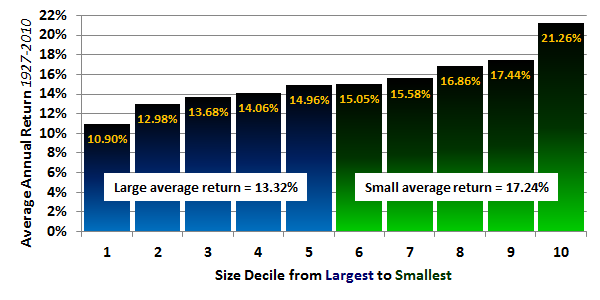
The 'size' factor has been a popular, longstanding risk premia, first identified by Rolf Banz in 1981. The factor is simple to follow: mid- and small-cap stocks (<$10B market cap) generally outperform large-cap stocks (>$10B market cap). The thesis seems to be borne out by empirical evidence:

Or does it? There have been criticism of the size factor in the past, but research from AQR shows convincingly the real dynamic at play: Quality (consistency of earnings, low debt/equity ratio,higher margins, etc.).
AQR provides a lot of evidence that after you adjust for their higher market beta, small-caps stocks do not outperform large-cap stocks. Shown below from monthly regression (1990-2020) on market factor plus lag (to take into account greater illiquidity of small cap stocks):
The smallest stocks have an average beta of 1.35 and negative alpha! No statistically significant SMB premia.
But if you take into account quality (in a separate study)...higher quality small cap stocks do outperforms large cap stocks. Adjust for quality, then you'll reap the size premium.
Felicidades España, los Campeones del Mundo!!
An imperious defense and dazzling passing helped La Roja to win the World Cup Fewest Goal Conceded in World Cup: 1 Golden Ball (Best Playe...
-
Russian oligarch Roman Abramovich purchased Chelsea FC in 2003 for £140 million (£60 million for the club plus £80 million of debt). His la...
-
This is more a discussion than a "debate" between two giants of the economics profession. Both are Democrats and agree on the basi...
-
Even though many of us are still working from home and days of the week can sometimes meld into one another, the weekend still seems to (and...